

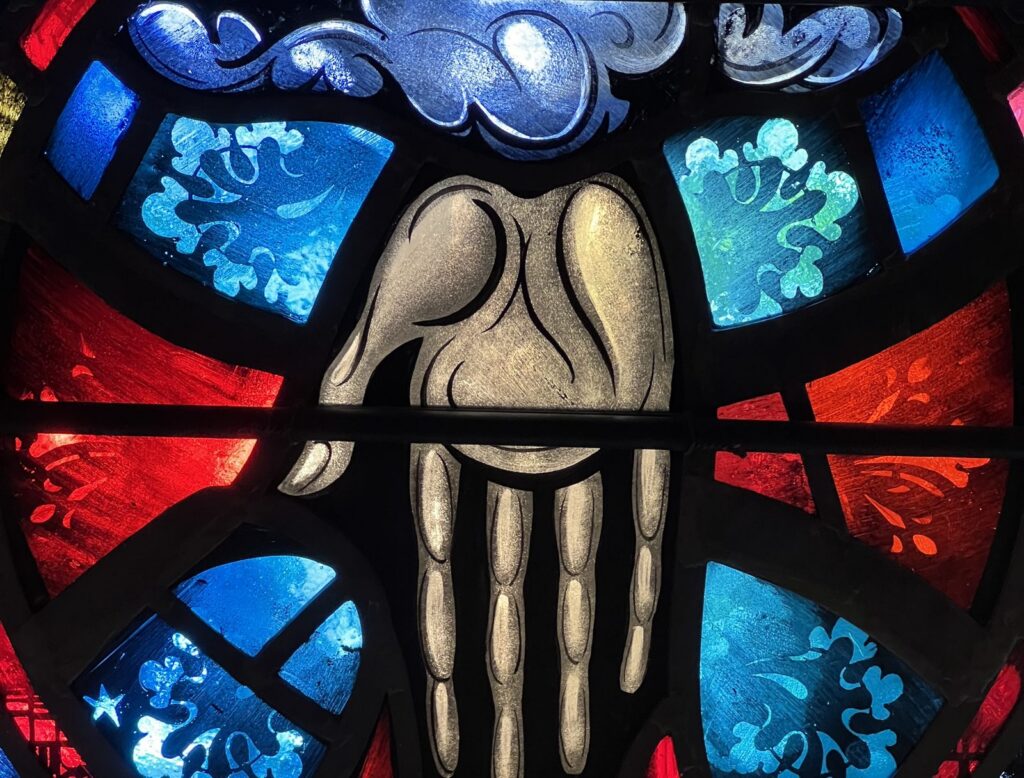
This is part 1 of 4 in Light Through Glass, a series on the stained glass windows of Epiphany Parish.
“But you are a chosen race, a royal priesthood, a holy nation, God’s own people, in order that you may proclaim the mighty acts of him who called you out of darkness into his marvelous light.”
— 1 Peter 2:9
When and Where Were These Windows Made?
The sanctuary windows at Epiphany Parish were created in 1951 by Charles J. Connick Associates of Boston, Massachusetts, one of the most celebrated stained glass studios in American history. Charles J. Connick (1875-1945) opened his studio at 9 Harcourt Street in Boston’s Back Bay in 1913, operating it, in his own words, “like a Renaissance guild,” a community of 40 to 50 skilled craftsmen working side by side. Connick rejected the painterly opalescent style of Tiffany in favor of the jewel-toned, symbolically rich tradition of 12th- and 13th-century medieval glass, emphasizing pure color, linear design, and the deep relationship between a window and the architecture it inhabits. His book, Adventures in Light and Color, set forth these principles for a generation of artists and designers.
Connick died in 1945, but his employees carried on the studio under the name Connick Associates, continuing to produce windows in the same medieval tradition for four more decades. Throughout its history the studio produced approximately 15,000 windows for more than 5,000 churches, schools, hospitals, and libraries across the United States and beyond. The studio archives are now preserved at the Boston Public Library and MIT. Epiphany’s windows, made six years after Connick’s death by his trained associates, stand in that same living tradition: glass as theology, color as proclamation, and light as the medium through which God speaks.
Why These Windows Exist
To step into Epiphany Parish is to step into a space designed with purpose. Every window, every color, every figure in glass and lead was crafted to do one thing: help you find your most authentic self as a follower of Jesus. The light outside does not simply illuminate the room; it passes through story, symbol, and scripture to dapple your life with meaning.
The windows do not ask you to imitate Jesus from a distance. They invite you to see yourself in his story. When you gaze at the crucifixion, you are invited to consider your own suffering. When you see the resurrection, you are reminded of where you are going. When you stand before the transfiguration, you are called to your own most glorious self.
The Language of Color
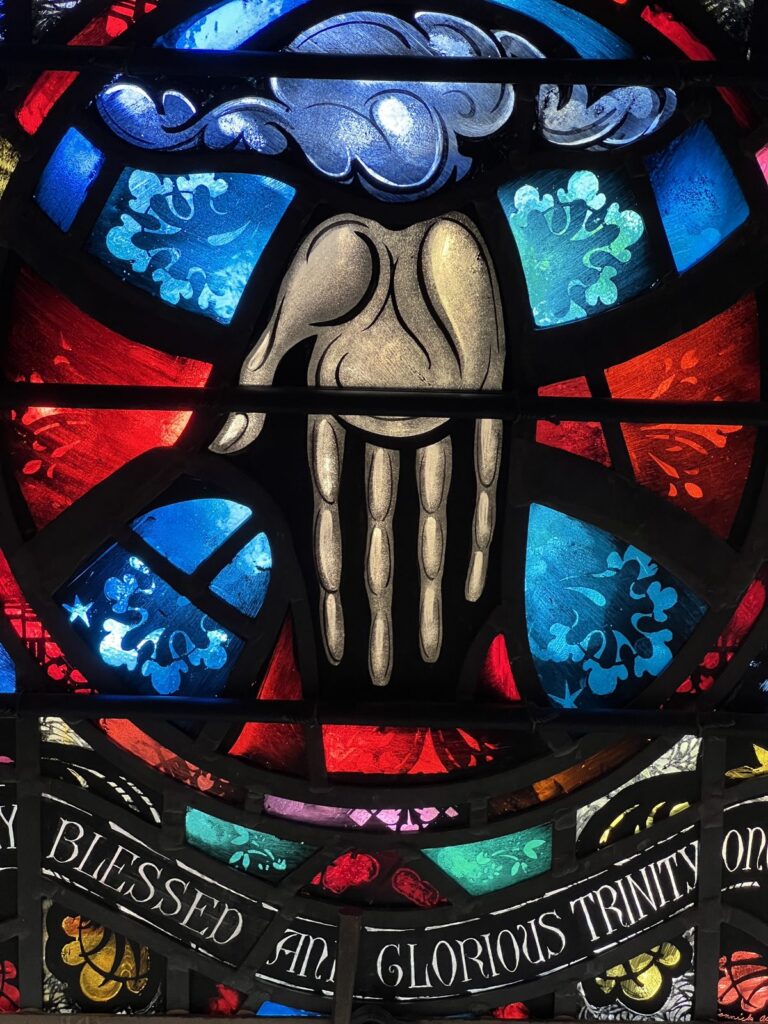
The windows at Epiphany speak first through color. In the early church, red was the color of majesty, power, and action, worn by popes, bishops, and cardinals. Blue, by contrast, belonged to the poor. Then, in 1130, the construction of Saint-Denis Basilica in Paris changed everything.
For the first time, stained glass windows combined red and blue, and something remarkable happened: blue was elevated. In a church lit entirely by colored light, the mingling of red and blue produced a violet radiance, what one might call a “dappled” light, that transformed both colors. Blue came to represent Mary, the contemplative life, and our eternal nature. Red came to represent the royal, active, outward life. Together they express the two natures present in every person who enters this space.
At Epiphany, these two colors continue that tradition. Red is the long arc of light, the action and priesthood of God’s people. Blue is the short arc, the contemplative and the eternal. In the violet light they make together, you find yourself: royal and priestly, temporal and eternal, fully human and called to be fully alive.
The Entrance: Two Doors, Two Commandments
Before you reach the windows, you pass through two great oak doors in which are set six stained glass panels. These panels depict six figures from the Hebrew scriptures: Abraham, Moses, David, Elijah, Isaiah, and Jeremiah. But the doors carry a deeper logic than their figures alone.
Each door represents one of the two great commandments: love God and love your neighbor. The patriarchs, prophets, and kings of Israel are woven into those commandments, so that when you walk through the doors, you are walking through the whole sweep of covenant history on your way toward its fulfillment in Jesus Christ. You enter already held within the story.
Adapted from Light Through Glass: A Guide to the Stained Glass Windows of Epiphany Parish, by the Rev. Doyt Conn, Rector.